A little bit about Geelong wine

Geelong is a deceptively diverse wine region. Stretching from the Moorabool Valley through the Bellarine Peninsula and down the Surf Coast, it encompasses different soils, exposures and microclimates.


That diversity is part of what makes the region so interesting. Pinot Noir, Chardonnay and Shiraz are among the varieties Geelong is particularly known for, but Riesling, Pinot Gris, Cabernet Franc, Syrah and a growing collection of other varieties all have a place here.


For us, the most exciting thing is the range of voices. There are producers working with old vines and established vineyards alongside a newer generation exploring site, farming and winemaking in different ways.

By Farr

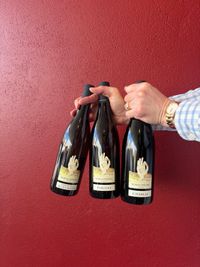
If you know Geelong wine, chances are you know By Farr. Gary Farr and his family have been making some of the region's most sought-after wines from the Moorabool Valley for decades, with a focus on small parcels and wines that balance power with detail. Nick Farr now at the helm is making some of Australia's best wines, right here on our doorstep.


The range we're particularly interested in includes Shiraz, Pinot Noir, Chardonnay and Viognier. There's a real sense of precision across the wines, but they never feel overly worked or polished at the expense of place.


By Farr has also picked up some serious recognition along the way. The Real Review named Wine by Farr Australian Winery of the Year in 2022 and again in 2025 — a reflection of the consistency and standing the winery has built over time.


At Claret: Look for By Farr Pinot Noir, Chardonnay, Shiraz and Viognier.

Bannockburn Vineyards

Bannockburn is one of the names that comes up again and again when talking about serious Geelong wine, and for good reason. Established in 1976, the estate sits in the Moorabool Valley and has become particularly associated with Pinot Noir and Chardonnay, alongside a broader range of varieties. A fun fact: Zara's dad worked at Bannockburn 20+ years ago as the vineyard manager when Gary Farr was the chief wine maker.


The 1314 range is a particular favourite of ours, especially the 1314 Pinot Noir and Shiraz. The Estate wines give you another perspective on the vineyard, with Pinot Noir, Chardonnay, Riesling and Sauvignon Blanc all represented.


There's also something very nice about being able to drink Geelong wine while sitting at our bar in Geelong. Right now we're pouring the brand-new 2026 Estate Riesling, which is a pretty good excuse to come in and try a glass.


At Claret: 1314 Pinot Noir, 1314 Shiraz, Estate Pinot Noir, Estate Chardonnay and Estate Riesling.

Provenance

Provenance has been making wine in the region since 1997, with a focus on vineyard provenance and wines that express where their fruit comes from. It's a producer with a particularly strong connection to Shiraz, but the broader Provenance portfolio reaches well beyond it.


We love the Geelong Shiraz, particularly for the combination of cool-climate structure, savoury character and regional identity. Provenance is also a good reminder that Geelong Shiraz doesn't need to be a big, heavy wine to have presence.


At Claret: Provenance Geelong Shiraz.

Mulline

Mulline is one of the newer Geelong producers that has quickly become a name worth knowing. Since launching in 2018, winemaker Ben Mullen and the team have built a portfolio that explores the region's different sites rather than treating Geelong as one uniform place.


In 2025 Mulline was named the 2025 Halliday Best Value Winery. Highlighting that value will never go out of fashion, something that Conor and I will always be passionate about when you step through the doors at Claret.


The range spans Pinot Noir, Riesling, Pinot Gris, Skin Contact Pinot Gris and Syrah, with single-vineyard wines offering an even closer look at individual sites. We particularly like the way Mulline approaches Pinot Gris. The classic version is fresh and textural, while the skin-contact bottling takes the variety somewhere altogether more savoury and interesting.


At Claret: Mulline Pinot Noir, Riesling, Pinot Gris, Skin Contact Pinot Gris, Single Vineyard Pinot Noir and Syrah.

Oakdene

Over on the Bellarine Peninsula, Oakdene has long been part of the Geelong wine conversation. It's a producer with a broad range, but there are a few bottles we find ourselves coming back to.


The sparkling is an easy place to start, particularly if you're looking for something local to celebrate with. If you're curious about how Australian sparkling fits into the wider world of bubbles, we've also written about Champagne vs sparkling wine.


The Blue Label Pinot Noir and Blue Label Shiraz show another side of the Bellarine, with wines that have plenty of regional character without losing their drinkability.


If you find yourself down along the Bellarine, their Cellardoor & restaurant Mr Grubb should be top of the list for a visit.


At Claret: Oakdene Sparkling, Blue Label Pinot Noir and Blue Label Shiraz.

Circulus

Circulus is one of the newer names we're particularly excited about in the Geelong region. Based at Coatsworth Farm on the Bellarine Peninsula, Circulus is a small, family-run project making wines that feel distinctly shaped by their maritime home.


John White and his wife Kim purchased the property in 2021, bringing John back to a long-held passion for wine after a 30-year career in finance. The vineyard is surrounded by sea breezes and is being farmed regeneratively, with a focus on improving the health and biodiversity of the site.


The name Circulus — a circle — makes a lot of sense when you hear the story. It's about coming back to a dream, but also about the circular approach to the land: composting, cover crops, integrated livestock, biodiversity and reducing the resources brought in and out of the farm.


The wines are vibrant, cool and savoury, with a real sense of maritime influence. We particularly like the Cabernet Franc, Syrah and Pinot Noir — three varieties that show just how broad the Geelong region can be.


At Claret: Circulus Cabernet Franc, Syrah and Pinot Noir.

Longboard / Bellbrae Estate

Down on the Surf Coast, Bellbrae Estate has been making wine since 1999, just minutes from Bells Beach. It's a particularly interesting part of the Geelong region, with the proximity to Bass Strait creating a maritime influence and relatively even temperatures through the growing season.


The wines are released under both the Bellbrae Estate and Longboard labels. Longboard is the more immediate, fruit-driven range — wines made to be enjoyed now, without too much ceremony. Bellbrae Estate sits at the more serious, age-worthy end of the spectrum.


The Longboard Pinot Noir and Chardonnay are the bottles we tend to reach for at Claret. They're bright, fresh and distinctly cool-climate, while still having enough flavour to work beautifully with food.


There's also a new chapter unfolding at Bellbrae. Simon Steele joined as viticulturist and winemaker in 2024 after almost a decade at Medhurst in the Yarra Valley, bringing a fresh perspective to an established Surf Coast estate. We're excited to see where the wines go from here.


At Claret: Longboard Pinot Noir and Chardonnay, with Bellbrae Estate releases as they land.

Geelong wine, according to Claret

This is by no means the complete list. Geelong has far more producers, vineyards and interesting bottles than we could fit into one article — and that's exactly why we like the region. Think of this as a starting point. If you know a producer, ask us about them. If you don't know where to start, tell us what you normally drink and we'll point you towards something local that makes sense.


One of the great things about being a wine shop and bar in Geelong is that we get to explore the region alongside the people who live here. Sometimes that means a serious bottle of Pinot Noir. Sometimes it's a glass of Riesling at the bar. Sometimes it's discovering a producer we'd never heard of six months ago. That's the version of Geelong wine we're interested in: local, curious, diverse and very much still evolving.


Come into Claret and explore a little bit of Geelong with us.


A few bottles we think are worth knowing about...


We always feel so lucky to be able to stock wonderful things on the shelf that we think will bring some level of discovery, excitement but above all else quality for you. Some are already established names. Others are producers we think you’ll be hearing us wax lyrical about in store. Either way, if you see something interesting on the shelf, ask us about it. We’re always happy to point you towards something new.


Good times call for Claret xx

Zara Wilkens

More Posts

We've Got a Soft Spot for ChardonnayWe've Got a Soft Spot for Chardonnay
We've Got a Soft Spot for Chardonnay

And by soft spot, we mean a fairly substantial one.


There's always a Chardonnay (or five) that's caught our attention at Claret. A beautiful bottle from Geelong, something particularly special from Burgundy, or a new discovery that's had us talking about it for days. We love the stuff.


Which is why we find it a challenge to change your mind when someone walks into the shop and confidently announces, "I don't drink Chardonnay."


Oh, really?

How Long Does Wine Last Once Opened?How Long Does Wine Last Once Opened?
How Long Does Wine Last Once Opened?

And yes, the red wine should go in the fridge too.


You opened a bottle last night and did not finish it.


First, congratulations on your restraint. Second, how long do you have before the wine loses the things that made you open it in the first place?


The honest answer is that every wine is different. Some are best on the night they are opened. Some remain delicious for several days. Some appear quiet on day one and become far more expressive overnight. There is no universal countdown clock, but there are a few things you can do to give an open bottle a better chance.


The short version is simple: Seal it, refrigerate it and reduce the amount of air sitting above the wine where possible. Yes, that includes red wine.

How Cold Should Wine Be?How Cold Should Wine Be?
How Cold Should Wine Be?

A practical guide to serving temperature, fridge time and drinking wine however you like it.


Wine people can become very particular about temperature.


Sparkling must be served at precisely this number. Chardonnay must be removed from the fridge at exactly that moment. Red wine must be served at room temperature, whatever that is supposed to mean in an Australian kitchen in January.


We are not here to confiscate your ice cubes. If you like your wine properly cold, drink it properly cold. If you enjoy a cube or two in the glass on a hot afternoon, nobody from Claret is coming to your house to stop you.


It is still useful to understand what temperature does to wine. Serving a wine colder or warmer changes how much aroma, flavour, acidity, alcohol and texture you notice. Once you know that, you can choose the temperature that makes the wine taste best to you.


Here is the useful version.

A practical guide to bottles, bubbles and making sure the good times don’t run dry.A practical guide to bottles, bubbles and making sure the good times don’t run dry.
A practical guide to bottles, bubbles and making sure the good times don’t run dry.

Planning a party involves several important questions.


How many people are coming? What are we feeding them? Do we have enough ice? Who said they were bringing chairs? And, most importantly, how much wine do we actually need?


Buy too little and the final hour becomes a cautious examination of what remains in the fridge. Buy too much and, well, you have wine left over. Of the two possible problems, we know which one we would prefer.

The amount matters, but so does the mix. The difference between a party that was perfectly nice and one your friends whisper approvingly about for weeks may come down to whether you bought enough bubbles and remembered that not everyone wants the same kind of white wine.


If you would like to skip straight to the numbers, use the Claret Party Drinks Calculator. Tell us about your guests and what you plan to serve, and we’ll prepare your suggested shopping list.


Otherwise, let’s talk through it.

<p>How to Decant Wine Without Overthinking It</p><p>How to Decant Wine Without Overthinking It</p>

How to Decant Wine Without Overthinking It

Decanting wine can look suspiciously like one of those rituals designed to make everyone at the table feel they have missed an important class.


There is the beautiful glass vessel. The careful pouring. The serious expression. Occasionally, a candle.


But the useful version is much simpler. You decant wine for one of two reasons: to give it air or to leave sediment behind. Sometimes both. That is really it. A decanter can help a young wine relax, allow a quiet wine to become more expressive and separate an older wine from the sediment that has gathered in the bottle. It can also make the table look very good, which is not the primary purpose but is certainly not a drawback. Here is how to decant wine without turning dinner into a formal examination.

<p>Does Wine Glassware Really Matter?</p><p>Does Wine Glassware Really Matter?</p>

Does Wine Glassware Really Matter?

Yes.


Not just for the aesthetic, although we are certainly not pretending the vibes are irrelevant. Wine simply feels better in a good glass. And, let’s be honest, the wine does cry a little when it is served in something with a chunky rim and a stem built like a table leg.


The right glass does not need to be painfully expensive, reserved for special occasions or designed for one very specific grape grown on one particular hillside. It just needs to help the wine be its best self.


That means giving the wine enough room to move, enough space for its aromas to collect and a fine enough rim that you notice the wine rather than the vessel carrying it.

<p>How to Choose Wine When You Don’t Know What You Like</p><p>How to Choose Wine When You Don’t Know What You Like</p>

How to Choose Wine When You Don’t Know What You Like

Choosing wine can be intimidating.


Perhaps you are standing in a wine shop looking at several hundred labels, none of which are giving much away. Perhaps you are in a restaurant, everyone has handed you the wine list, and a server is waiting while you pretend to understand the difference between two villages in Burgundy.


We have all been there.


Wine has its own language, and that language is not always particularly helpful. People start talking about red apples, green apples, ruby plums, black plums, graphite, forest floors and pencil shavings. Before long, the wine sounds less like a drink and more like a fruit salad served inside a stationery cupboard.

The good news is that you do not need to know the right wine words to choose something delicious.


You just need to know how you want the wine to feel.

Geelong Wine Without the Road Trip How to Taste the Region Closer to HomeGeelong Wine Without the Road Trip How to Taste the Region Closer to Home
Geelong Wine Without the Road Trip How to Taste the Region Closer to Home

A day spent driving between Geelong cellar doors is a very good day.


There are vineyards, long lunches, rolling hills, coastal views and the deeply satisfying feeling that comes from buying wine approximately twelve metres from where it was made.

But sometimes you want to explore Geelong wine without organising an itinerary, appointing a designated driver or committing an entire Saturday to the cause.


Good news. You can start much closer to home.


Whether you order a local wine by the glass, build a few-bottle tasting from the shop or simply choose one producer you haven't tried before, there are plenty of ways to get to know the region without embarking on a full cellar door tour.


Orange Wine, Explained Without the LectureOrange Wine, Explained Without the Lecture
Orange Wine, Explained Without the Lecture

Orange wine tastes as good as it looks. Sometimes peachy and tropical, sometimes floral and savoury, often textural, always capable of making a table look approximately 40 per cent more fun.

It can also attract explanations with the length and emotional weight of a minor thesis. We will not be doing that. Here is orange wine without the lecture: what it is, why it has colour, what it tastes like and where to begin.

Zara Wilkens | Sep 21

Geelong Wine Producers: A Claret Guide

We'd love to say we stock everything Geelong has to offer. We absolutely do not. There are simply too many good wines, too many small producers and not enough shelf space. Rather than attempt to create a definitive list of the best Geelong wineries, we've put together a Claret edit of some of the local producers currently on our shelves, in our fridges or on our bar list. These are wines we like, drink, pour and come back to. Some are established names that have helped put Geelong on the map; others are newer producers we're excited to watch. The common thread is that they tell us something interesting about where they're from.